_edited.png)
What Is the Difference Between Revenue, Profit and Cash Flow?
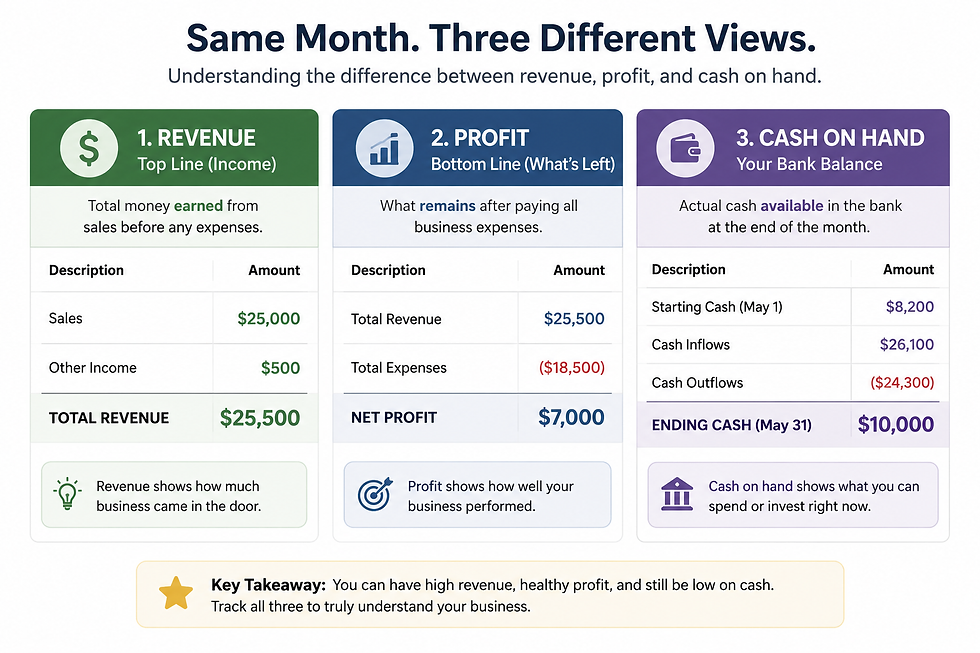
In one sentence: revenue is all the money coming in, profit is what's left after all your costs, and cash flow is the timing of money actually moving in and out of your bank account. They sound similar, but they answer three different questions — "Are people buying?", "Am I making money?", and "Can I pay my bills this week?" — and a business can look great on one while quietly failing on another.
Here's each one in plain English, with a simple example, and why the difference is one of the most important things a new owner can understand.

Revenue: the money coming in
Revenue (also called sales or "top line") is the total amount you charge customers before any expenses. If you sell 100 items at $50, your revenue is $5,000. Revenue tells you whether people are buying — but on its own it says nothing about whether you're keeping any of it. High revenue with high costs can still mean zero profit.
Profit: what's left after costs
Profit (the "bottom line") is revenue minus all your expenses — materials, labor, overhead, taxes, everything. If that $5,000 in revenue cost you $4,200 to produce and run, your profit is $800. Profit answers the real question: is this business actually making money? You can grow revenue every month and still lose money if your costs grow faster.

Cash flow: the timing of money moving
Cash flow is about when money actually lands in and leaves your account — not what you've earned on paper. You can be profitable and still run out of cash if customers pay you in 30 days but your rent, payroll, and suppliers are due now. This timing gap is why profitable businesses sometimes can't make payroll: the profit is real, but the cash hasn't arrived yet.
The SBA stresses solid bookkeeping and knowing your basic business finances precisely because tracking the timing of cash — not just totals — is what keeps the doors open.
Why the difference matters so much
Most small businesses that fail aren't unprofitable on paper — they run out of cash. Understanding all three lets you answer the questions that actually keep you in business: Are sales strong (revenue)? Am I keeping enough of it (profit)? And can I cover what's due right now (cash flow)? A healthy business needs all three, not just one.
Frequently asked questions
Can a business be profitable but still go under?
Yes — this is the classic cash-flow trap. If the money you're owed arrives after your bills are due, you can be profitable on paper and still unable to pay what you owe.
Which number should I watch most closely?
Watch all three, but for day-to-day survival, cash flow is king. Profit tells you if the business works long-term; cash flow tells you if you make it to next month.
Is revenue the same as income?
In everyday use people say "income" loosely, but technically revenue is the money in before costs, and net income (profit) is what's left after. Keeping them separate in your head prevents costly mistakes.
How do I improve cash flow without more sales?
Invoice faster, ask for deposits, tighten payment terms, and time big expenses carefully. Managing timing can fix cash flow even when revenue stays flat.
Want to actually stay on top of your numbers?
This article covered the what and the why. The Quicke Business Collective's Business Starter Program walks you through the how — setting up simple systems to track revenue, profit, and cash flow so nothing sneaks up on you.

Questions?
Email info@quickemarketing.com ·


Comments