_edited.png)
How Much Should I Set Aside for Small Business Taxes?
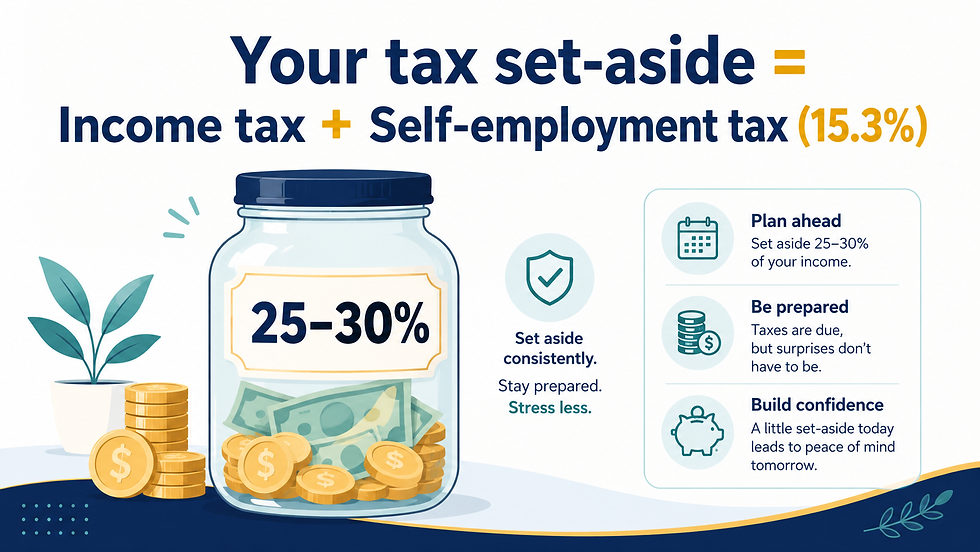
A common, practical rule of thumb is to set aside 25–30% of your net business income (what's left after expenses) for federal taxes — sometimes more once state taxes are added. That range works for many self-employed people because it has to cover two things a W-2 employee often forgets: regular income tax and self-employment tax. The safest habit is to move that percentage into a separate savings account every time you get paid, so the money is already there when taxes are due.
Here's why the number is higher than people expect, and how quarterly payments fit in.

Why self-employment tax makes your bill bigger
When you work for someone else, your employer quietly pays half of your Social Security and Medicare taxes. When you work for yourself, you pay both halves — that's self-employment tax. Per the IRS, the self-employment tax rate is 15.3% (12.4% for Social Security and 2.9% for Medicare), and the Social Security portion applies up to an annual wage-base limit the IRS adjusts each year.
That 15.3% is on top of your ordinary income tax — which is exactly why setting aside only what you'd expect as an employee leaves new business owners short at tax time.
You may need to pay quarterly, not just in April
The IRS is a pay-as-you-go system. If you expect to owe $1,000 or more when you file, the IRS generally requires quarterly estimated tax payments using Form 1040-ES, spread across four payment periods during the year. Miss them and you can owe an underpayment penalty — even if you pay in full in April.
This is another reason to set money aside continuously: those quarterly due dates come faster than you'd think.

A simple system that works
Pick your percentage (start around 30% if you're unsure), and every time a client pays you, immediately move that share into a separate "taxes" account you don't touch. When a quarterly payment is due, it comes from that account. Adjust the percentage as you learn your real numbers. It's not glamorous, but this one habit prevents the most common and stressful money problem new owners face.
Frequently asked questions
Is 30% enough?
For many self-employed people, yes — but it depends on your income level, your state, and your deductions. Higher earners and those in high-tax states should lean toward the top of the range or higher, and confirm with a tax professional.
What counts as the income I apply the percentage to?
Your net business income — revenue minus deductible business expenses — not your total sales. Tracking expenses well can meaningfully lower what you owe.
What if I don't set enough aside?
You'll owe the balance at filing, possibly with penalties for underpaying during the year. If that happens, pay what you can and talk to the IRS or a professional about options.
Do I really have to pay quarterly?
If you expect to owe $1,000 or more, generally yes. Paying quarterly also spreads the cost out so you're not hit with one large bill.
This article is general information, not tax advice. Your situation varies — consult a qualified tax professional or the IRS for your specific numbers.
Want a tax set-aside system you'll actually keep up with?
This article covered the what and the why. The Quicke Business Collective's Business Starter Program walks you through the how — building the simple money habits and systems that make tax time a non-event.

Questions?
Email info@quickemarketing.com ·


Comments