_edited.png)
How Should I Price My Products or Services?
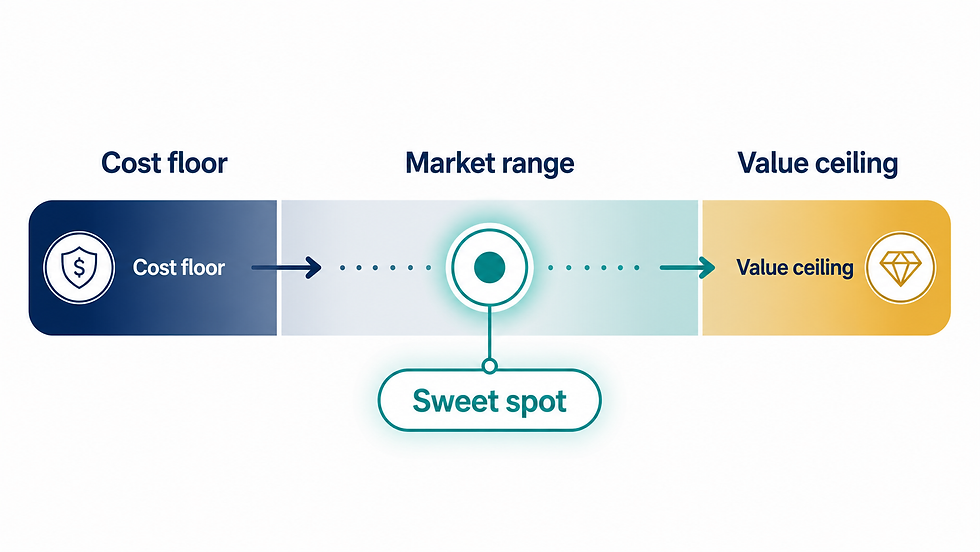
Every good price has to do three things at once: cover what it truly costs you to deliver, sit within what your market will actually pay, and reflect the value your customer gets. Most pricing mistakes come from focusing on just one of those — copying a competitor's price without knowing your own costs, or setting a number that "feels fair" without checking what the work really takes. Get all three talking to each other and you price with confidence instead of guilt.
Here's how to think about each one, and why "just charge a little less than the other guy" is such risky advice.

Start with your true costs (the floor)
Your price can't go below what it costs you to deliver, or you lose money on every sale. That sounds obvious, but "cost" is bigger than most new owners think: it's the direct cost of the product or service plus a share of your ongoing overhead — the same one-time and monthly expenses the SBA lists for any business, from software and insurance to your own time. If you don't fold overhead and your labor into the number, a "profitable" price can quietly lose money.
This is your floor. Any price below it isn't a discount — it's a subsidy you're paying your customer.
Check what the market actually pays (the range)
Next, find the range real customers pay for something like yours. The SBA's market research guidance points you to exactly this: what customers currently pay, how saturated the market is, and how competitors position themselves. You're not copying a competitor's price — you're learning the range so you can place yourself in it deliberately.
Pricing far below the range can signal "cheap" and attract bargain-hunters; pricing above it can work beautifully if your value justifies it.
Reflect the value you deliver (the ceiling)
Two businesses can do the "same" thing and charge very differently because one solves a bigger problem, saves more time, or reduces more risk. Value-based thinking asks: what is the result worth to the customer? A price anchored to value — not just hours or materials — is usually higher, and customers accept it when the outcome is clearly worth it.
Why "charge a little less" backfires
Competing on being the cheapest is the hardest game for a small business to win. It attracts price-sensitive customers, erodes the margin you need to survive slow months, and leaves nothing to reinvest. Almost always, the better move is to be clearly worth more to a specific type of customer than to be a few dollars cheaper for everyone.

Frequently asked questions
Should I just match my competitors' prices?
Use competitor prices to learn the range, not to set your number. You have different costs and a different value story, so copying a price can lock you into losing money.
How do I know if my price is too low?
If you're busy but not profitable, or you feel resentful about the work, your price is likely below your true cost. That's a signal to recalculate, not to work more hours.
Is it better to raise prices or cut costs?
Often raising prices is faster and safer than cutting costs to the bone, because deep cost-cutting can hurt quality. The best answer usually involves both, done carefully.
How often should I revisit pricing?
At least once a year, and any time your costs, offering, or market shift. Prices aren't set once — they're maintained.
Want to price with confidence instead of guessing?
This article covered the what and the why. The Quicke Business Collective's Business Starter Program walks you through the how — building your real numbers and setting prices that actually keep you profitable, step by step.

Questions?
Email info@quickemarketing.com ·


Comments